PEAK HIGH Mountaineering

The Mountaineering and Rock Climbing in South Africa Blog

Powered by Genesis

You are here: Home / Archives for Admin

Sleeping Bags

1 November 2022 by Admin

Sleeping bags are very important parts of a mountain walker’s equipment. They will be the main source of warmth during the coldest times of day and night. They differ in two main areas, firstly in their shape and secondly in what they are filled with.

Regarding shape they are basically either rectangular or a mummy type shape. The rectangular type has a large area around the leg area making for a more comfortable and looser feel. It is also easier to manufacture and so is cheaper in price. This shape however, also means that there is more area to heat up by the body (colder) and more fabric used which makes it heavier than necessary. Mummy type bags on the other hand are warmer, lighter and are the preferred shape of any properly designed product.
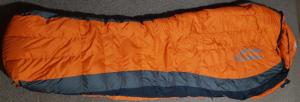
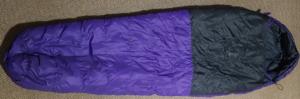
Mummy shaped sleeping bag with cowl

The filling inside a sleeping bag gives the bag loft, which is the amount of thickness of the layers when un-rolled. This gives a good indication of how much warmth the bag potentially can retain. The filling inside a sleeping bag can be roughly divided into 3 main types: cheap synthetic, hollowfibre and down. Cheap synthetic is exactly what the name implies and should only be considered for casual trips in warm climates. It has little real warmth or lightness, but is cheap. Hollowfibre is a filling made of very fine hollow filaments that trap air inside them and between them. It is a fairly warm filling and retains its warmth when wet. They have a life span of about 10 years if looked after. It has the advantage of being cheaper than down, however, it will not compress as well as down and is also heavier. Down, on the other hand is the first choice for high quality sleeping bags. They are light, have more warmth per weight of filling, compress more easily and last forever if looked after well. The disadvantages are that they lose most of their warmth when wet, are hard to get dry and are far more expensive. The advantages of down far out weigh the disadvantages, making down the preferred choice in most instances.

The internal construction of sleeping bags is very important. In both hollowfibre and down bags there are two major design types. These are sewn-through type construction and a baffle type construction. Both these construction types are to create separate compartments so that the filling does not shift around and remains fairly evenly spread thoughout the bag.

The sewn-though type allows for warmth to escape through the constricted areas where the inner and outer pieces of fabric are brought together. This is a major disadvantage and is not used on well-constructed sleeping bags.

Sewn through construction. Cheap and light bags.

Baffle type bags have compartments where the two outer layers of fabric are kept apart by a separate inner wall. These compartments have different designs, which could be a zigzag pattern or rectangular shape depending on the manufacture.

Zigzag baffle type

Box wall type

Box wall types are good but not the warmest, they are lighter than V type and costs less.

Brick wall type

Brick wall types have good insulation, are heavier and more costly, expedition type bags.

Trapevoid type

Trapevoid types are a combination of box and V types. They are often used in high quality bags.

Most sleeping bags have zips in them to make getting in and out of the bag more comfortable. Zips can vary from a few centimetres in length to a full zip, which runs all the way along one side and across the foot area. Two identical bags of this type can usually be zipped together to form a double sleeping bag.
Filed Under: Mountain Walking

Hiking Backpacks

1 November 2022 by Admin

Tips for choosing a hiking backpack


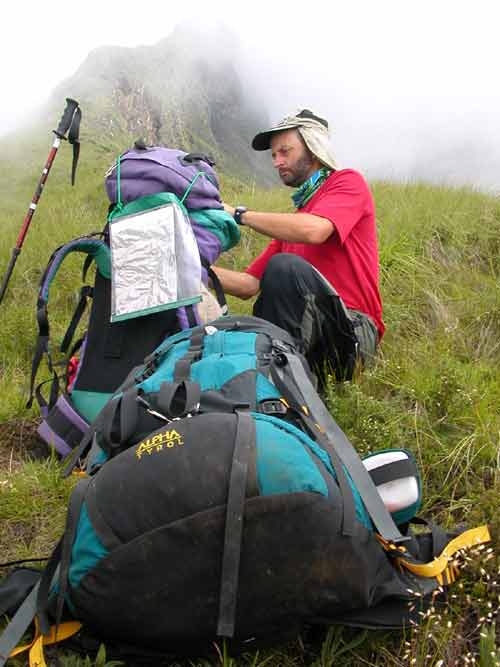
Back Pack and Gavin

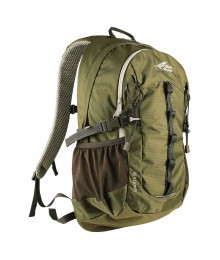
Hiking Backpacks

Backpacks need to be made of a water resistant fabric, be very durable, comfortable and the correct size for the number of items to be carried. Making sure that the backpack is comfortable and well adjusted is extremely important as, if this is done badly, the whole expedition can become very un-enjoyable.

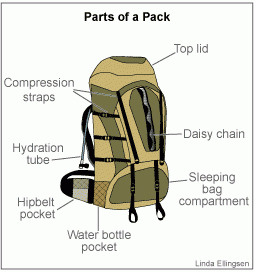
Design: There are two major design criteria in Backpacks today. These have to do with how and if they have a frame i.e. external frame, internal frame or no frame. The other consideration is if it is a day bag or an expedition rucksack. Day bags are made for short outings and typically come in sizes up to 35 litres in capacity. They will also usually have no frame at all or may have a soft internal frame. Expedition bags come in sizes from about 40 litres up to 100 litres. They are used for long trips and either have an internal or external frame. Note that these expedition bags are then again divided into two fairly distinctive bag types. The actual bag itself either has lots of internal and external pockets so that items can be accessed easily. This type of design is useful for ordinary mountain walking. On the other hand, some people prefer a design where there is just a single huge compartment. These bags are common with mountaineers and climbers and are often about 50-60 litres in size and have internal frames. Most backpacks today are made of a water resistant material such as Cordura.

Note that this is not waterproof as it does allow for water to escape during dry times and so stops the internal area of the bag becoming mouldy and damp. Backpacks should also have wide, well padded shoulder and hip straps. The shoulder straps (upper point of attachment) must also be able to be moved up and down the back area of the bag. This allows for the bag to be fitted to different sizes of people.

Fitting the Backpack

Most expedition bags available in South Africa today are of an internal frame design and so this section only explains how to adjust a bag for internal frames. Firstly the internal frame needs to be moulded to take the shape of the wearer’s back. Do this by bending the frame while the bag is empty. Make sure that it fills the lower hollow of the back and curves around the shoulders. Then remember that the hip strap should take between about 50% and 70% of the overall weight carried. The upper attachment points of the shoulder straps can usually be adjusted up or down depending on the length of the wearer’s torso. The upper attachment should be at about the shoulder blade height of the wearer. There are straps that join the upper curve of the shoulder straps to the back of the main bag. These need to be fairly tight so as to hold the bag forward against the shoulder.

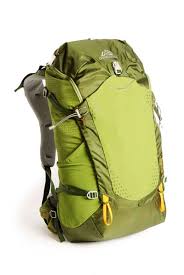
A well designed 20 litre day bag.

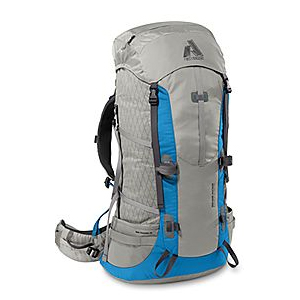
A large 65+ litre expedition bag.

A 35 litre day bag.

Packing a Backpack

The rule here is, “heavy high, light low”. This simple rule just helps to remind you that it is more comfortable to carry heavy items if they are pushing down on the upper shoulders and not hanging below the wearer’s back. Light items such as sleeping bags, spare clothing and a tent flysheet can be carried in the bottom of the bag. Heavy items such as tent poles, stove, fuel and food are carried in the upper area of the bag. There is always a danger of liquid fuels leaking and so these items are best carried in an external pocket within a sealed bag. The same goes for any other liquids that may leak. As backpacks are never fully waterproof it is a good idea to place sleeping bags and clothing in plastic bags or to fit a large garbage packet inside the bag before packing. Try to keep bad weather shell equipment near the top of the bag where they are easily accessible. Tent poles can be placed separately and vertically into the bag as this saves space. Make sure that maps and the compass are easily accessible.

Filed Under: Mountain Walking

Hiking Tips: Mountain Hazards

1 November 2022 by Admin

Watch out for the following hazardous conditions in the Drakensberg

1    Bad visibility caused by bad weather (mist, rain, snow) or by darkness is a major hazard in the mountains. This lack of visibility causes other problems to develop. For instance, any lack of visibility can cause walkers to get lost. This in turn causes people to take short cuts along unknown routes, accidentally walk off steep ground or cliffs or to have party members get dangerously tired or dehydrated.

2    Snow falls cause extremely cold and wet conditions. Remember that although snow is seen as “fun” it is not pleasant to walk in falling snow, neither to camp in it. Watch for hypothermia. When snow falls thickly it can become almost impossible to walk through and can trap a whole group for days at a time. Snow and ice can also make a simple path into a very dangerous place especially if there is a steep drop off nearby.

3    Rock falls happen from time to time especially during heavy rain or snow.  Watch for loose overhanging rock in places where a hiking party must pass nearby.

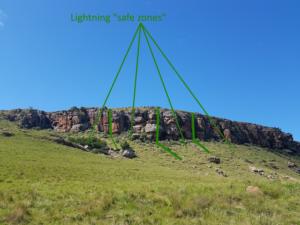
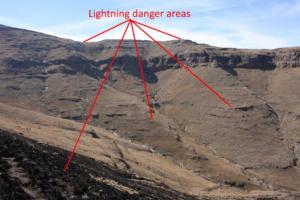
4    Lightning is major problem in the summer months in most areas of southern Africa.  If a storm is approaching, move away from ridges or the summits of peaks. Get into lower ground with plenty of high points set well away from the party. A good place is the safe zone near to a small cliff. To work out where to sit, estimate the height of the cliff and then sit the same distance away from it at the base. Then to make it safer, get members to sit down on their haunches with their feet on any insulating material such as a rucksack or ground sheet. Place any large metal items well away from the party (e.g. tent poles)   Sitting on the haunches is the best way to sit out a storm, since if a strike happens close by and current runs through the ground, it will most likely run through only the persons legs and not the vital organs and head. Lying down on the ground will mean that any current will run right though the whole body.  Also get the party to spread out (minimum of 10m apart). In the event of a person being struck it will have less chance of jumping across and hitting more members.

Lightning-safe-zones

Lightning-danger-zones

Avoid sheltering near or under isolated trees, buildings or rock pinnacles.  Rock fissures and small caves are not good places to shelter either as the current tends to travel along these lines of weaknesses.  Also be careful when near metal fences.  Lightning can strike the fence many kilometers away and the current flows along the fence, injuring anyone holding it.

5    Flash floods can occur in narrow valleys or streambeds  when a storm occurs up stream. Remember that the storm could be so far away you may not know of its presence.  Small streams can become flooded in a matter of seconds.

6    Rain and wind is a very common mountain hazard.  Conditions become slippery, wind may be strong enough to make people stumble about and even destroy tents.     Watch for hypothermia in these conditions.

7     Hypothermia is a condition when the body’s core temperature drops below 32?C . This condition is called Mild hypothermia. If untreated the body temperature can drop further to temperatures as low as 28?C and is called Severe hypothermia.  Mild hypothermia is a dangerous condition which is usually brought on in the mountains by a person having wet clothing coupled with heat loss from windy conditions. The early symptoms of mild hypothermia are shivering, feeling cold, irritability, impaired speech, un-coordinated movements and stumbling when walking.

A leader must learn to recognise these symptoms in members of their party.  The party must stop as soon as possible, get the patient into dry, warm clothes and out of the wind. They can be given hot, sugared drinks to aid recovery.

If unchecked Severe hypothermia can set in. This is a life threatening condition! Shivering stops, the patient cannot walk or stand, they become completely incoherent, will often say they “feel warm” and even take their clothes off. One can also take their temperature to confirm their dangerous state.

If severe hypothermia occurs to a member of a party the whole group must stop and set up camp immediately.  Get the patient into dry clothes and into a dry sleeping bag under shelter.

Do not try to apply too much heat too quickly to the patient’s extremities, as this draws warm blood away from the vital organs.   Rather let the patient slowly warm up in a sleeping bag with warm items applied to the chest region (e.g. hot water bottle or warmed rock).

For both Mild and Severe hypothermia a good way to warm the patient is to have another person climb into the sleeping bag with them. If severe hypothermia has been encountered the patient should be moved to hospital as soon as possible.

Remember that if the body temperature carries on dropping they will eventually lose consciousness and die soon afterwards.

8    Heat exhaustion and dehydration is usually caused by hard physical work during very hot conditions in direct sunlight. The body loses too much water and cannot get rid of heat fast enough. The patient will get very thirsty, feel dizzy, tired, their tongue may become dry and they can even lose consciousness. Their eyes may become sunken and their body temperature my rise slightly.

To treat this condition move the patient to some shade, remove some clothing, pour water onto their clothing to aid cooling, give them cold water with a small amount of salt and sugar added.  If their body temperature continues to rise they must be taken to hospital as soon as possible as this is a sign of probable heatstroke.

9    Heatstroke can be caused by the same conditions as Heat exhaustion and has similar symptoms.  Symptoms can then also include delirium, convulsions and un-consciousness.  The rectal temperature will rise to above 40?C.  This is a very serious situation and most patients die unless treated immediately. Treat as for Heat exhaustion but also elevate the legs, fan the patient, ensure the air way is open if the patient becomes unconscious. Move to hospital as soon as possible.

10 Altitude Sicknesses are rare in the Drakensberg, but a few cases of Acute Mountain Sickness have been recorded and diagnosed by a doctor.  Elsewhere in Africa, however, these set of illnesses can be a real problem and even life threatening.  Mountains such as Mt. Kenya, Kilimanjaro and Mt. Stanley are all at the altitudes than can cause illnesses.

Rising altitude causes less air pressure and by proportion, less oxygen to breathe, a drop in blood PH and water retention. The chemical process in the human body by which this happens, is very complicated. The symptoms however, are usually clear to the observer and very apparent to the patient.

Symptoms and Types of Illnesses

Acute Mountain Sickness-  Although this is least dangerous condition it will still cause horrible symptoms  and make life extremely unpleasant.

– Tiredness/ headaches/ sleep apnea

Pulmonary Edema– As Acute Mountain Sickness with added  “rails” in chest/ coughing, fluid build up in the lungs, causing drowning- this is a  LIFE THREATENING CONDITION – DESCEND IMMEDIATELY AND SEEK RESCUE/MEDICAL HELP.

 Cerebral Edema– fluid forming on the brain- severe headaches/ disorientation/ AN EXTREMELY LIFE THREATENING CONDITION! DESCEND IMMEDIATELY AND SEEK RESCUE/MEDICAL HELP.

Treatment and Prevention

  • Ascend slowly > 3000m not more than 300m per day if possible
  • Climb high- sleep low. Climb up high, then come down and camp for the night.
  • Drink lots of water
  • Diamox –brings blood pH to normal and relives symptoms of Acute Mountain Sickness (beware of people with sulphur allergies)
  • Descend in the altitude if symptoms do not resolve in 12 hours.

11   Wild Fires 

Hiking in South Africa has the extra hazard of being caught in an uncontrolled fire, such as grass of low lying scrub such as vynbos that covers the western part of the country. In places like the Drakensberg, grass fires are also purposefully started in the winter months as part of eco management by the land managers. Controlled or uncontrolled fires can occur in the Drakensberg region from June to October.

If you find yourself in the path of such a fire do the following:

  • Get into a big river bed if there is one close by.
  • Get into thick temperate indigenous forests found on the southern slopes.
  • Carry matches or lighter- start a fire yourself and burn a big patch of grass and then step into the area once the heat has dissipated.

Filed Under: Mountain Walking

  • « Previous Page
  • 1
  • …
  • 33
  • 34
  • 35
  • 36
  • 37
  • …
  • 40
  • Next Page »

Gavin Raubenheimer
Cell: 082 990 5876
Web: www.peakhigh.co.za
Facebook: Peak High Mountaineering

Categories

  • Climbing
  • Course dates
  • Drakensberg Information
  • Expert Witness
  • Gear Sales and Advice
  • Guided Training
  • Hiking
  • Hiking Tips
  • Information Sheets
  • Mountaineering tips
  • Past Courses & Guided Trips
  • Peak High Guides
  • Peak High Technical
    • Climbing
    • Mountain Walking
  • Photo & Film Shoots
  • References